The Design Context
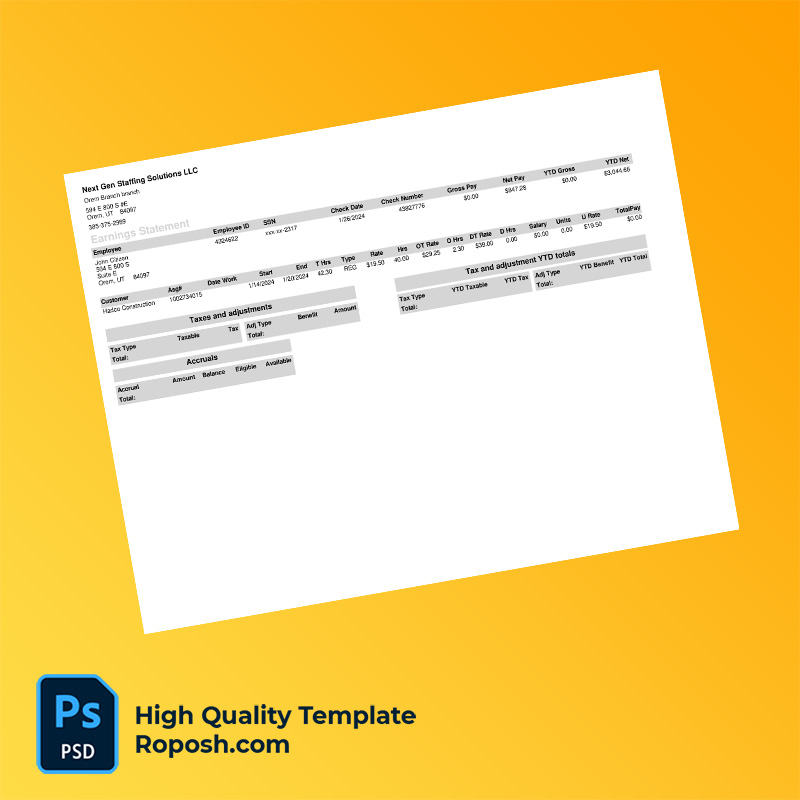
In professional graphic and print design, delivering high-fidelity templates is paramount. Whether assembling design portfolios, educational mockups, or client-ready documents, precision and quality mark the difference between a standard template and a premium resource. Many designers face challenges sourcing layouts with pixel-perfect accuracy—where font sizing, spacing, and margins must align flawlessly to avoid distorted prints or low-quality digital renderings. Our Next Gen Staffing Solutions LLC earning statement word and pdf template addresses this pain point directly by incorporating standardized layout dimensions and vector-sharp text borders, ensuring visual integrity across all platforms. This template serves as a reliable asset in professional environments where design accuracy supports operational credibility and client satisfaction.
Addressing Layout & Font Challenges
Font consistency and border clarity often become problematic in editable templates, frequently resulting in blurry edges or mismatched typography that compromise the document’s professional look. This template solves such issues with exact font matching sourced from widely supported font libraries, coupled with clean layer organization for effortless modification. Its structured layering means that text, graphical elements, and images reside on distinct, logically named layers, enabling users to edit without disturbing the layout’s balance.
For an educational perspective on achieving OCR-friendly and print-accurate design, Review our guide on OCR-friendly Design to complement your template customization workflow.
Technical Specifications Deep Dive
This earning statement template utilizes a 300 DPI resolution, ideal for sharp print outputs and high-quality digital presentations. The color mode is set to CMYK, aligning with professional print standards for color fidelity and accuracy in physical reproductions, but also compatible with RGB for digital usages.
The file incorporates Smart Object functionality within its PSD components, allowing designers to replace or update embedded elements without quality loss. Vector shape layers ensure that text borders retain crispness regardless of scaling, a crucial factor for various print sizes.
To expand your project resources, consider integrating complementary templates such as an Editable Utility Bill PSD to add cohesiveness to related documentation projects.
Editing Workflow & Customization
Editing the template involves straightforward manipulation of text layers in software like Microsoft Word and Adobe Photoshop. Replace placeholders by selecting text layers to input company-specific data such as employee names, earnings, or dates. Images or logos inserted as Smart Objects can be swapped by double-clicking the Smart Object layer, adding a new image, saving, and closing, which updates the main template seamlessly.
Special attention is given to structural fields such as MRZ and barcode placeholders, which are designed with locked vector layers to preserve the standardized layout while allowing visual customization. This ensures the integrity of complex elements during edits.
Expand your editable resource library with related assets such as the International Business Document PSD for diverse design needs.
Exporting & Printing Best Practices
For final output, export the template to PDF or PNG formats using high-quality export settings—300 DPI or higher—to maintain sharp detail. PDF format is recommended for multi-page documents and print submissions, while PNG suits digital distribution.
When producing physical prototypes or client proofs, select coated or matte finish papers with 120gsm or higher to replicate professional statement materials authentically. Properly configured color profiles in CMYK ensure print colors remain true to design intent.
Complete your document set with finishing assets like the High-Resolution Official Document PSD template, perfect for complementary print projects.


Reviews
There are no reviews yet.