
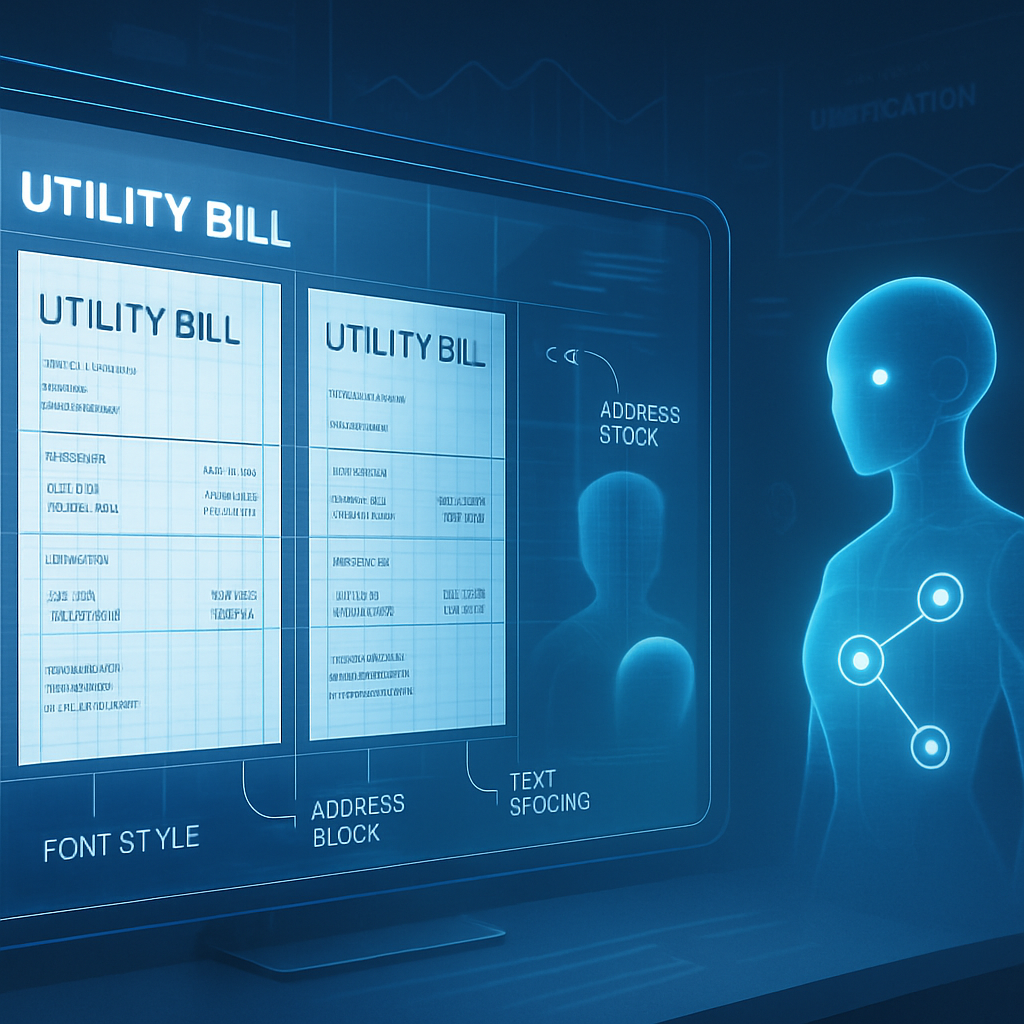
When submitting utility bills for Stripe, many users encounter unexpected rejections despite providing valid documents. Understanding why a Stripe verification failed error occurs is essential for businesses aiming to streamline onboarding and avoid delays caused by technical mismatches rather than missing paperwork. The challenge often lies in subtle formatting issues such as font mismatches, text alignment, and address precision rather than the document’s presence itself.
This article delves into the mechanics behind Stripe utility bill verification, highlighting how AI-driven checks assess specific criteria like font consistency and exact data matching. By learning how to address common causes—such as inconsistent address formatting and font recognition errors—you can improve submission success rates. We’ll guide you through a step-by-step process to adjust document templates for compliance, paired with examples of properly formatted utility bills to help you meet Stripe’s automated standards more efficiently.
Let’s explore how precise formatting tweaks and data accuracy can resolve frequent Stripe utility bill rejection issues and ensure smoother document handling.
Understanding why Stripe verification fails for utility bills is crucial for businesses relying on smooth onboarding. This article explores the technical factors behind frequent rejections, including common mismatches overlooked in typical guidance.
- Identify AI verification criteria: Stripe’s automated system scrutinizes documents for precise font styles and text alignment beyond mere document presence.
- Address precision matters: Exact matching of names, addresses, and formatting reduces rejection risks caused by subtle discrepancies in submitted bills.
- Diagnose common rejection causes: Many failures stem from font recognition errors and inconsistent address formatting rather than missing documents.
- Follow a step-by-step correction process: Adjust fonts, align text fields, and verify address data systematically to align with Stripe’s verification standards.
- Leverage examples of compliant bills: Reviewing sample utility bills with proper formatting helps ensure submissions meet Stripe’s AI expectations.
- Understand hidden technical pitfalls: Overlooking font matching and address layout nuances often leads to false negatives during AI document checks.
- Consult best practices for submission: Applying consistent template styles and verifying data accuracy maximizes approval chances.
Next, we’ll break down the specific formatting tweaks and verification steps that can help resolve Stripe utility bill verification failures effectively. These insights focus solely on technical compliance for document verification and are intended for informational use in improving submission quality.
Why Stripe Rejects 40% of Utility Bills (And How to Fix It)
Stripe’s verification engine rejects a significant portion of utility bills submitted for identity confirmation due to technical mismatches rather than outright document invalidity. These rejections often stem from format inconsistencies, font mismatches, or minor data alignment errors that automated AI models flag as suspicious.
Understanding the precise causes behind these rejections is key to creating editable utility bill templates in Word, PDF, or PSD formats that pass Stripe’s scrutiny smoothly. By addressing these areas upfront, users can reduce editing time, maintain consistent formatting, and ensure submitted documents meet Stripe’s strict technical criteria.
This foundation leads us to delve into how Stripe’s AI examines these documents and what checks are most critical for passing verification.
How Stripe’s AI Verifies Utility Bills
Overview of Stripe’s Automated Document Checks
Stripe leverages Optical Character Recognition (OCR) combined with machine learning models that analyze document layout, text clarity, and data integrity. The AI does not only check for the presence of a bill but performs deeper inspection on document structure, assessing the validity of fonts, spacing, and alignment across fields.
Its focus on both visual and textual elements means that even small formatting discrepancies can cause failures, making template consistency essential throughout the editing and submission processes.
Key Verification Criteria: Fonts, Text Alignment, and Data Accuracy
- Font style and size consistency: Stripe’s AI expects fonts commonly used in official utility bills. Deviations or uncommon font choices may trigger rejection.
- Exact alignment of text fields: Names, addresses, account numbers, and dates must align precisely, adhering to spatial expectations to facilitate automated field extraction.
- Precise matching of names and addresses: Submitted data must exactly match the extracted text, considering spelling, abbreviations, and consistent formatting.
Technical Factors Behind Utility Bill Rejection
Rejections often result from subtle issues such as text bleed, slight misalignments, or font substitutions caused by software defaults. Many templates that appear visually correct to humans are flagged because OCR interprets their irregularities as signs of tampering or forgery.
With these technical verification standards in mind, let’s explore common reasons your utility bill submissions might fail Stripe’s AI checks and how to resolve them.
Common Reasons for Stripe Utility Bill Verification Failures
Font Recognition Errors in Submitted Documents
Fonts that are too stylized, custom, or that have irregular kerning patterns can confuse Stripe’s AI. Many editable templates default to generic system fonts which differ significantly from those used by most utilities. This mismatch affects OCR accuracy and leads to rejection.
Inconsistent Address Formatting and Data Mismatches
Data fields such as addresses sometimes include abbreviations or line breaks inconsistent with Stripe’s expected standard formats. For example, “St.” versus “Street” or variations in postal code placement confuse automated text matching algorithms.
Subtle Text Alignment Issues and Template Irregularities
Even minor shifts in baseline alignment or inconsistent padding around text boxes for names and account numbers disrupt Stripe’s field detection. Template irregularities—such as uneven spacing or overlapping layers in PSD files—pose additional risks.
Understanding these failure points prepares you to take concrete steps to fix your utility bill templates, ensuring higher acceptance rates.
Step-by-Step Guide to Fixing Utility Bill Verification Errors
Step 1: Confirm Accurate Name and Address Data Entry
- Verify that the name and address data you enter into templates match exactly the source documents, down to punctuation and abbreviations.
- Use consistent address formats compliant with local postal standards to avoid discrepancies.
Step 2: Use Correct, Stripe-Compatible Fonts
- Research commonly used fonts for utility bills in your region (e.g., Arial, Helvetica, Times New Roman) and replicate them in your editable documents.
- Set font embedding options in PDFs and rasterize text layers carefully in PSDs to avoid font substitution during export.
Step 3: Align Text Fields Precisely
Use snapping guides, gridlines, and alignment tools provided by Word, PDF editors, or Photoshop. Maintain consistent margins and padding around key fields such as the customer name, service address, and account number boxes.
Testing alignment by overlaying your template with screenshots of verified utility bills can help improve accuracy.
Step 4: Verify Document Quality and Resolution Before Submission
Export PDFs without compression to retain sharpness. For PSD exports, flatten only nonessential layers and maintain high resolution (minimum 300 dpi) to prevent blurring.
Review the final file on multiple devices to ensure text clarity and legibility necessary for Stripe’s OCR to function optimally.
With these corrective measures in place, reviewing real-world template examples will clarify how to embed these best practices visibly.
Examples of Properly Formatted Utility Bills for Stripe Verification
Examining High-Compliance Utility Bill Templates
Top-performing utility bill templates often feature clean typography, consistent text alignment, and streamlined address formats. For instance, templates maintain:
- Font sizes ranging between 10pt to 12pt with clear hierarchy.
- Left-aligned customer addresses with no line breaks within street names.
- Consistent spacing between lines to avoid crowding.
Editable utility bill templates for global verification incorporate these features, making them suitable starting points for customization.
Case Studies of Successful Stripe Utility Bill Submissions
Consider the USA Entergy Louisiana Utility Bill Template, which follows traditional US utility standards and uses system fonts such as Arial at 11pt. Its address format closely mirrors postal standards, reducing AI mismatch issues.
Similarly, the Kenya Power & Lighting Utility Bill Template adopts concise address lines and standardized font usage corresponding to Kenyan utility bill conventions.
Both examples demonstrate that leveraging region-specific editable templates reduces the need for repeated corrections and speeds up approval.
Best Practices for Consistent Stripe Utility Bill Submissions
Maintain Uniform Template Styles Across Documents
Consistency is critical. Using the same template structure and font set for all document versions builds a recognizable pattern for Stripe’s AI, decreasing false negatives. Avoid mixing fonts or varying text alignment from one submission to another.
Regularly Update Address and Account Information for Accuracy
Frequent updates to templates with fresh data aligned to utility accounts ensure current records reflect exactly what Stripe expects. Employ spell-check and address validation APIs if possible to eliminate typos before generating bills.
Leverage Editable Templates to Streamline Compliance
Editable templates in Word, PDF, or PSD formats allow rapid adaptation while preserving formatting fidelity. These templates let you control layers, font settings, and alignment grids, minimizing manual correction effort.
Explore the detailed Utility Bill Template Guide for tailored tips on fine-tuning your documents to meet verification standards.
Once underway with these best practices, it’s helpful to be mindful of common missteps that continue to trigger Stripe rejections.
Technical Pitfalls to Avoid in Stripe Utility Bill Verification
Overlooking Font Matching Leads to Frequent False Negatives
Failing to use or embed correct fonts causes OCR to misinterpret characters, notably when default fallback fonts appear in exports. This is a leading cause of unnecessary rejections, as Stripe’s AI expects a recognizable “font fingerprint.”
Ignoring Text Alignment Disrupts Automated Data Extraction
AI algorithms rely on spatial consistency; irregular or uneven placement of names, addresses, and numerical fields confuses the extraction logic. Avoid free-hand adjustments without grid checks in your editing tools.
Failing to Cross-Verify Address Layout Variations
Minor variations, such as extra line breaks or inconsistent abbreviations, make exact data mapping challenging for Stripe’s system. Cross-verifying your template layout against official utility bill examples from the region can eliminate these pitfalls.
For troubleshooting common Stripe rejection causes and developer insights, see Stripe Verification Failed Causes & Troubleshooting.
Conclusion
Addressing the common reasons why Stripe rejects utility bills—such as font inconsistencies, misaligned text fields, and data formatting errors—is essential for creating editable utility bill templates that facilitate smoother submissions. By understanding Stripe’s AI verification criteria, including its emphasis on font style, text alignment, and exact data matching, users can design documents that significantly reduce rejection rates.
Utilizing customizable templates in Word, PDF, or PSD formats empowers users to maintain consistent formatting, apply region-specific standards, and manage precise layout controls. This not only streamlines the editing process but also ensures that exported documents retain the quality and clarity required for reliable OCR processing. Templates that embed system-compatible fonts and adhere to local postal address formats enhance both speed and accuracy in verification workflows.
Moving forward, maintaining uniformity across all submitted documents and regularly updating data entries will bolster the integrity of utility bill submissions. Embracing these best practices not only minimizes avoidable technical pitfalls but also optimizes the balance between efficiency and detail orientation. For those aiming to elevate their document preparation, the challenge lies in continuously refining templates to align with evolving verification standards and leveraging editable tools to achieve precision at scale.