


The Design Context
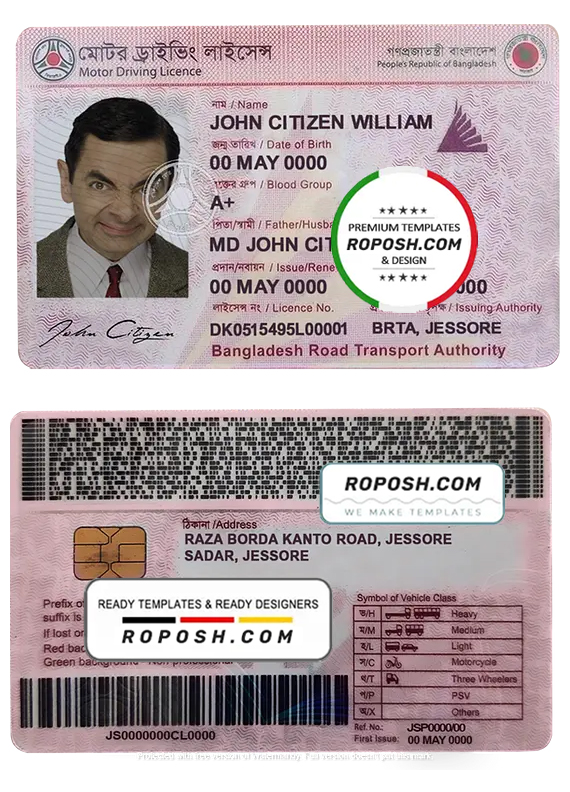
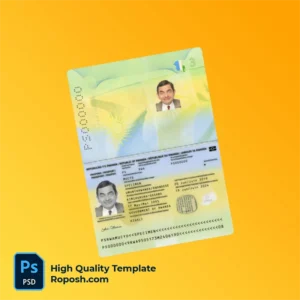
In professional graphic design and print production, access to high-fidelity editable templates is crucial for achieving exceptional quality and accuracy. This Bangladesh driving license template in PSD format, version 3, addresses the industry’s demand for pixel-perfect layouts that complement portfolios, educational mockups, and client presentations. Designers and print shop operators often face challenges locating or creating templates that replicate the exact standardized dimensions and typography used in official documentation. This template ensures all visual elements conform to rigorous graphic standards, optimizing usability and reliability for lawful design illustration and educational projects.
Addressing Layout & Font Challenges
The template expertly resolves common pitfalls such as font mismatches and blurred edges through the use of exact font matching and vector shape implementation. Organized with meticulously named layers and grouped for straightforward navigation, it enhances editing efficiency, allowing users to focus on precision without layout compromises. The MRZ (Machine Readable Zone) and barcode layers are designed with proper hierarchical structure, maintaining the document’s structural integrity during customization. For expanded insights on OCR-friendly and print-accurate designs, please review our guide on OCR-friendly Design.
Technical Specifications Deep Dive
This PSD template is configured at 600 DPI, meeting high-resolution standards ideal for professional print outputs and mockups. The design uses CMYK color mode to guarantee color accuracy on physical prints. Smart Objects incorporated within the PSD allow for non-destructive editing of photographic elements and complex graphics, while vector layers keep text borders sharp and scalable. This vector approach eliminates pixelation risks, ensuring that elements such as text and official symbols retain crispness regardless of resizing. To complement your project assets, consider adding the editable utility bill PSD for integrated ID verification materials.
Editing Workflow & Customization
Users should begin by opening the PSD in Adobe Photoshop, accessing clearly labeled text layers grouped by information categories such as name, date of birth, and license number. Editing text layers uses correct font families embedded or referenced in the package to maintain authenticity. Photo replacement is facilitated via Smart Objects; double-clicking these layers allows insertion of new images without affecting surrounding elements. Special attention is given to MRZ and barcode layers: these are locked to prevent accidental distortion but can be edited with recommended tools to preserve their standardized layouts. For expanding your editable document collection, explore the USA New Jersey death certificate Word and PDF template.
Exporting & Printing Best Practices
After editing, export your design in high-quality PDF or PNG formats ensuring preservation of color profiles and resolution settings. For physical proofs or final print, using matte or gloss-coated paper with weight between 200-300 gsm is recommended to emulate official license texture. Careful printer calibration is essential to uphold color fidelity and edge sharpness. To complete your professional asset library, add the Uruguay driver license PSD template for comparative regional design versatility.
Layer & Field Breakdown
| Layer Group | Description | Editable? | Sample Data |
|---|---|---|---|
| Background | License base texture and coloration | No | Official watermark patterns |
| Text | Personal information fields and headings | Yes | Name, DOB, License No. |
| MRZ Layer | Machine-readable zone with standardized formatting | Yes (with caution) | >BGBD1234567890< |
| Photo Placeholder | Photo Smart Object for easy replacement | Yes | Applicant’s portrait |
| Barcode | Encoded license data | Editable | Code 128 barcode |
Precision Editing for Professional Results
For best outcomes, engage layer locking strategically to avoid accidental misalignment of critical elements such as barcodes and MRZ zones. Preserve fonts by installing all required typefaces before editing and always utilize Smart Object functionality to ensure that image updates do not degrade quality. When modifying sensitive zones, consult official dimension guidelines integrated within the layers to maintain exact spatial relationships. This precision fosters output consistency, making the template ideal for a wide array of educational, portfolio, and illustrative professional scenarios.
Reviews
There are no reviews yet.