


The Design Context
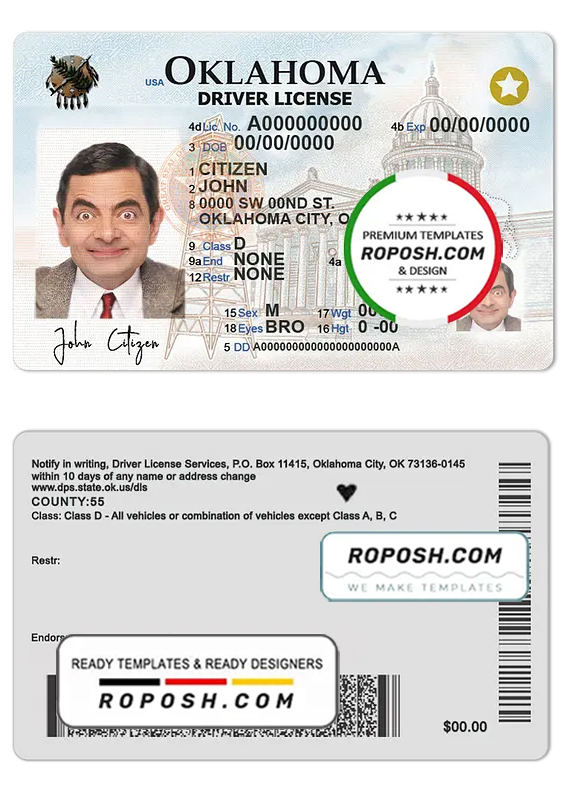
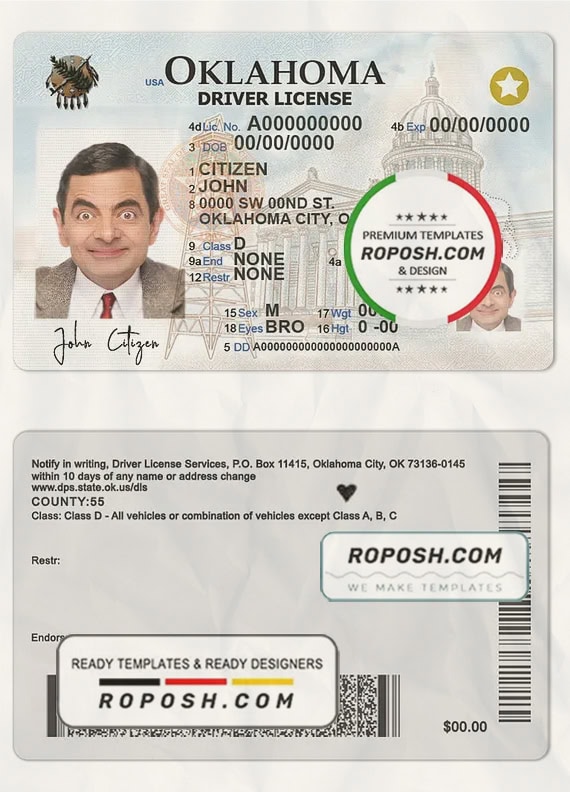
In professional design environments, access to high-fidelity, pixel-perfect templates is critical for building credible portfolios, educational material, and detailed mockups. Particularly for identity and licensing documents, accuracy in layout, font, and graphic elements ensures that final presentations possess the necessary clarity and precision for evaluative or illustrative purposes. The USA Oklahoma driving license template in PSD format addresses this demand by delivering an expertly crafted design file that combines exact layout dimensions, strict adherence to typographic standards, and comprehensive layer organization. This template eliminates common challenges designers face when sourcing authentic layouts, enabling higher productivity without compromising on quality.
Addressing Layout & Font Challenges
One of the most frequent difficulties in driver license design stems from incorrect font matching and blurred text borders. This template solves those by incorporating vector-sharp text borders and exact font usage that matches the official license specifications. Furthermore, the PSD layers are systematically grouped and named, facilitating intuitive navigation and precise editing. Designers no longer need to spend excessive time correcting misaligned elements or recreating missing details. For an expanded understanding of design techniques that improve OCR resilience and typographic accuracy, review our guide on OCR-friendly Design, offering expert insights on layered PSD document preparation.
Technical Specifications Deep Dive
This template is provided at 600 DPI resolution to ensure crisp output on both digital displays and professional print substrates. Its CMYK color profile aligns with industry printing standards, guaranteeing color fidelity in physical proofs. The file utilizes Smart Objects extensively to permit non-destructive edits to photographs and subcomponents, enhancing workflow efficiency. All text elements are constructed using vector shapes or type layers, ensuring scalability without distortion, which is crucial for maintaining edge sharpness and print clarity. The incorporation of a properly structured MRZ (Machine Readable Zone) layer matches regulatory formatting, supporting design accuracy. For complementary project requirements, users may consider the editable utility bill PSD, designed to harmonize with identity assets seamlessly.
Editing Workflow & Customization
To customize the template, open it in Adobe Photoshop or compatible software supporting layered PSD files. Text layers are clearly labeled and can be modified by selecting the Type tool, allowing for exact content updates including name, address, and license details. Image placeholders use Smart Objects; double-clicking these opens the embedded photo, which you can replace with your own high-resolution image, then save to update automatically. Special attention is required when editing barcode and MRZ layers—these comprise vector paths and text elements arranged to preserve official structure and scanability. Avoid rasterizing these layers to maintain their functional integrity. Add this asset to your design library along with the USA New Jersey editable document template to expand your collection of high-quality PSD sources.
Exporting & Printing Best Practices
When finalizing your design, export the file preferably as a high-resolution PDF or PNG to preserve details and color profiles. Use professional-grade coated or matte art paper with weight standards above 200 gsm to optimize tactile quality for physical mockups. Calibrated printers supporting CMYK output will produce results closest to the design intent. Maintain original PSD files for iterative edits, and archive exported versions alongside detailed project notes for version control. To complement your print assets, consider the Uruguay driver license PSD template, ideal for comparative portfolio pieces and international projects.
Layer & Field Breakdown
| Layer Group | Description | Editable? | Sample Data |
|---|---|---|---|
| Background | Base colors and patterns of the license | No | Oklahoma state colors, textured background |
| Text Elements | All license textual content including name, DOB, etc. | Yes | John Doe, 01/01/1990 |
| Photo Placeholder | Smart Object area for licensee image | Yes | Editable photograph |
| MRZ Layer | Machine-readable text zone | Yes (text only) | P<IDUSAJOHNDOE<<DOE<<JOHN<<<<<<<<<<<<<< |
| Barcode | Barcode vector element | Yes | 123456789012 |
Precision Editing for Professional Results
Achieving professional output requires meticulous adherence to file structure. Always preserve vector layers and Smart Objects during edits to avoid unintended quality degradation. Alter textual fields only within their designated layers to maintain spacing and alignment crucial for design conformity. When replacing images, ensure photo resolution matches or exceeds the template’s DPI to prevent pixelation. Take special care with MRZ and barcode layers by using supported font sets and vector formats to retain scanning compatibility. Employ layer masks over raster modifications to facilitate reversible changes. Regularly reference the standardized layout dimensions to confirm your edits meet the original specification. These practices ensure that your final asset remains crisp, precise, and aligned with high-end design standards.


Reviews
There are no reviews yet.