
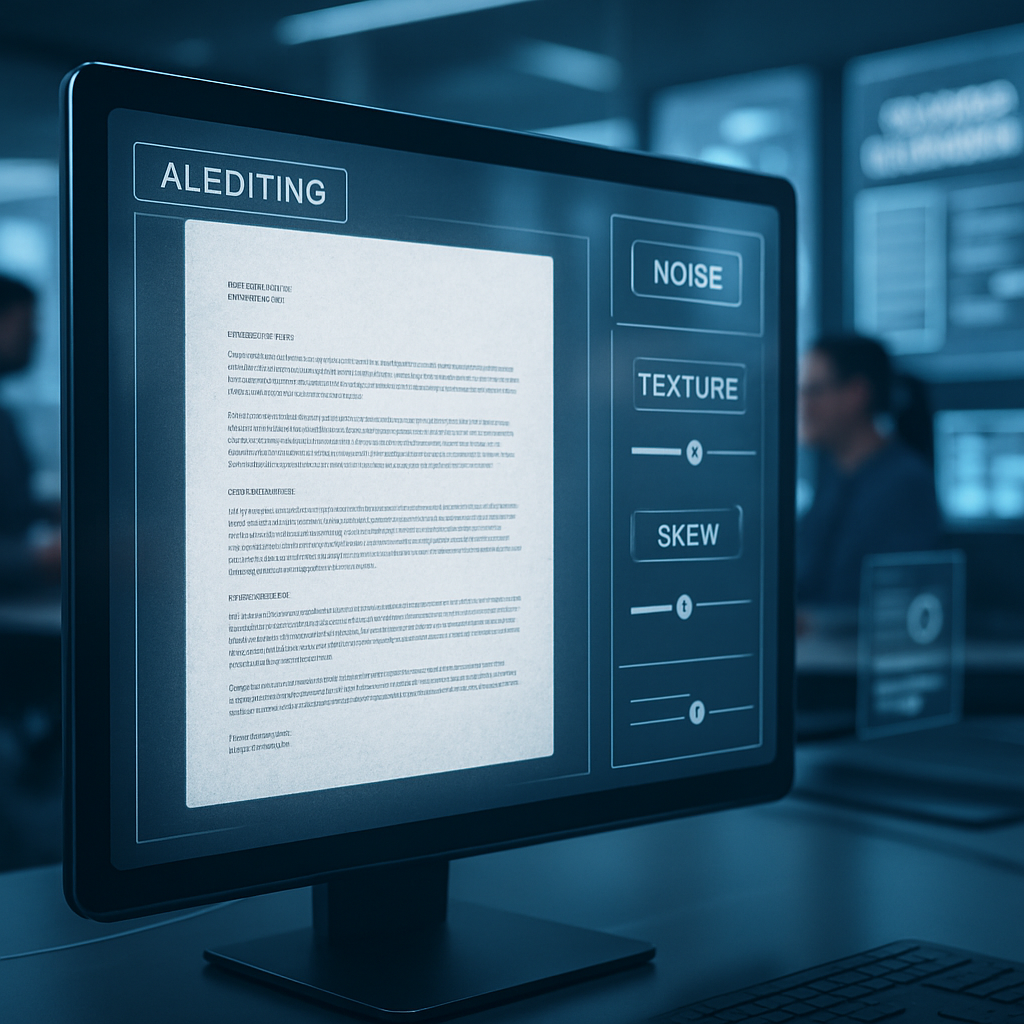
Struggling to make a digital file look convincingly scanned can slow down workflows and undermine document authenticity in automated systems. Understanding how to make document look scanned is essential for adding realistic textures, noise, and artifacts that mimic physical scans, enhancing visual credibility and improving recognition by verification bots. This approach ensures your documents maintain clarity while appearing suitably “imperfect” to scanners.
In this guide, you’ll learn effective techniques to apply document scan effects such as subtle grain, shadows, and skewing using AI-powered tools and editable templates. These methods provide faster, consistent results with clean exports formatted for various locales, helping streamline your design and compliance simulations. Let’s explore how to balance realism with legibility and integrate scanned document simulation seamlessly into your digital projects.
These templates and techniques are intended for design practice, mockups, and compliance simulations; they are not substitutes for official verification processes.
Making a digital document look scanned is essential for enhancing authenticity and ensuring automated systems recognize them as genuine. This guide explains how to apply realistic scan effects that simulate physical scans, improving both visual credibility and security.
- Add noise and texture layers: Integrate subtle grain, paper fibers, and scanning artifacts to mimic a real scan’s physical imperfections.
- Incorporate scan-specific artifacts: Use shadows, slight skewing, and faded edges to simulate common scanner-induced distortions.
- Understand bot verification requirements: Recognize that verification bots often reject pristine digital files lacking scan-like features to prevent tampering.
- Leverage AI-powered tools: Utilize modern software solutions designed to apply realistic document scan effects efficiently.
- Balance realism with legibility: Ensure that added textures or noise do not obscure essential details or reduce document clarity.
- Enhance security through visual authenticity: Realistic scanned appearances can reduce risks of digital copying and unauthorized edits.
- Explore tutorials and templates: Reference guides and editable templates can accelerate your process of achieving professional scanned-document simulations.
Next, the article will delve into step-by-step techniques for applying these effects using AI tools, addressing common challenges and optimizing your documents for automated systems. These templates and techniques are intended for design practice, mockups, and compliance simulations; they do not replace official verification processes.
Understanding the Importance of Making a Document Look Scanned
Creating editable document templates that mimic the appearance of scanned documents is crucial to achieve a balance between digital clarity and authentic visual cues. This approach is especially relevant for templates such as bank statements, utility bills, pay stubs, invoices, and passport PSD mockups where scanned aesthetics add credibility for presentation or mockup purposes.
Why Pristine Digital Files Are Often Rejected
Perfectly clean digital documents, while precise, often face rejection by automated systems or verification bots that are programmed to detect anomalies typically associated with forgeries. These systems expect certain imperfections such as scanner noise, slight skew, and texture artifacts that signal a genuine physical document was scanned. Pristine files miss these hallmarks, triggering suspicion.
Benefits of Realistic Scanned Document Appearance
- Enhances visual credibility: Subtle imperfections like noise and slight distortion simulate real-world scanning effects, making documents appear physically produced.
- Improves recognition and acceptance: Automated tools and bots programmed to filter submissions are more likely to accept documents that align with expected scanned characteristics.
- Reduces unauthorized digital copying: Scan-like texture and noise can act as a deterrent to straightforward digital edits, preserving template integrity.
With a clear understanding of why scanned aesthetics matter, it is essential to adopt practical techniques that effectively simulate these characteristics in editable document templates.
Key Techniques to Simulate Scanned Document Appearance
Adding Noise and Texture Layers
Noise and texture layers form the foundation of a scanned look. Introduce a lightly grainy texture to the document background by overlaying semi-transparent noise layers or paper fiber images. These should be subtle enough to avoid distraction but visible enough to break the digital smoothness. Incorporate scanned-paper textures, such as faint creases or uneven coloration, to enhance authenticity without compromising text legibility.
Incorporating Scan-Specific Artifacts
- Slight skewing: Apply a minimal rotation (typically 1–3 degrees) to the entire document or key sections to mimic the slight misalignment encountered during scanning.
- Shadows and faded edges: Use gradient shadows or feathered edges around the document borders to simulate scanner light diffusion and aging effects common in scanned images.
- Common scanning distortions: Introduce horizontal banding, faint streaks, or smudges selectively. These should be carefully applied to avoid compromising essential information but add a randomized natural imperfection.
Balancing Realism with Legibility
While these effects increase perceived authenticity, balancing them is critical. Overdoing noise or distortion risks obscuring crucial details such as names, numbers, or dates. Test readability at various zoom levels and ensure that all core information remains crisp and clear. Layer opacity, blur radius, and distortion angles should be fine-tuned accordingly.
Having covered key simulation techniques, the next step involves selecting the right tools and templates to efficiently incorporate these effects.
Tools and Software to Add Realistic Scan Effects
AI-Powered Solutions for Efficient Scan Simulation
Advances in AI enable quick, repeatable application of scanned-document effects. Specialized software powered by AI automatically generates noise, texture, skew, and artifact layers tailored to the document content. These tools reduce manual adjustments and ensure consistent results across multiple documents or batches.
Manual Editing Techniques in Popular Software
- Photoshop: Utilize layered PSD files to overlay paper textures, apply noise filters (e.g., Gaussian or Add Noise), and introduce distortions using warp or skew tools. Layer masks help localize effects without impacting text clarity.
- PDF editors: Adjust brightness/contrast and apply subtle filters to simulate scanner output. Some editors support adding scanned backgrounds or texture images behind editable text layers.
- Word templates: Use preset styles for scanned-look effects, such as background fill patterns and mild distortions on text boxes, allowing quick edits without deep image manipulation skills.
Recommended Editable Templates and Resources
Starting with professionally designed editable templates accelerates producing scanned-document-like files. These templates often incorporate layered structures that segregate editable text from noise/texture layers and come pre-set with locale-correct currency and date formatting.
For example, consult specialized Utility Bill PSD Templates to ensure authentic scanned bill mockups with modifiable layers are readily available.
With the appropriate software and resources understood, it is practical to proceed with a hands-on approach detailing each step to simulate scanned effects effectively.
Step-by-Step Guide to Applying Realistic Scan Effects
Prepare Your Digital Document
- Finalize all editable content including account numbers, addresses, currency symbols, and date formats to match the target locale. This avoids rework after scan-effect application.
- Save a clean, high-resolution source version (minimum 300 DPI) to ensure quality retention during effect layering and export.
Apply Noise and Grain Layers
- Import subtle noise overlays or scanned paper texture images as separate layers above the background.
- Reduce the noise layer opacity to around 5–15% depending on document brightness, making sure the noise complements rather than overwhelms the content.
Add Scan Artifacts and Distortions
- Use transform tools to slightly skew the entire document or selectively chosen blocks to replicate misalignment during scanning.
- Apply soft shadows or feathered gradients along document edges for scanner light diffusion and aged paper effects.
- Overlay faint horizontal streaks or smudge brushes sparingly, focusing on empty spaces or non-critical areas.
Finalize and Export for Automated Systems
- Export to PDF format with settings optimized for 150–300 DPI to balance scan-like resolution and file size.
- Test document legibility across devices and screen sizes. Adjust noise intensity and contrast if necessary to maintain clarity without losing the scanned impression.
For a practical example, explore editable invoice templates applying these techniques here: Editable Invoice Template.
Having walked through the implementation, it is essential to address typical pitfalls and how to resolve them effectively.
Common Challenges and Troubleshooting Tips
Overcoming Excessive Noise That Obscures Details
- Implement layer masks on noise layers focused around text or numeric fields. This technique lets you preserve crystal-clear text while adding texture in background or margin areas.
- Adjust noise intensity dynamically based on document content density—heavily populated tables require lighter noise overlays than sparsely filled pages.
Dealing with Misalignment and Skewing Issues
- Limit skew angles to subtle degrees (1–3°) because too much rotation may confuse readers or make documents appear distorted rather than scanned.
- Preview the skew effect at various zoom levels and on different screen types to ensure a natural look that neither distorts nor degrades usability.
Ensuring Compatibility with Automated Verification Bots
After exporting your scanned-look documents, run tests against intended automated verification systems to confirm that your simulated effects meet expected visual criteria without triggering false negatives.
For reference examples, bank statement templates designed specifically with scanned-document realism can be reviewed here: Bank Statement Template.
Conclusion
Creating editable document templates that convincingly replicate a scanned appearance requires a careful blend of subtle noise, texture layers, and scan-specific artifacts such as slight skewing and faded edges. These design elements not only enhance visual authenticity but also improve compatibility with automated systems by meeting their expectations for scanned document characteristics. Equally important is maintaining legibility and locale-appropriate formatting while applying these effects to ensure the documents remain clear and professional.
Leveraging AI-powered tools alongside manual editing techniques in software like Photoshop, PDF editors, or Word streamlines the process, offering consistent, high-quality outputs. Beginning with well-structured editable templates—such as Utility Bill PSD Templates or Editable Invoice Template—provides a solid foundation that balances efficiency and customization for generating realistic scanned document mockups.
As you implement these strategies, focus on fine-tuning noise intensity and artifact placement to avoid obscuring critical information while preserving the authentic look. Testing across various devices and typical automated systems helps ensure the end result maintains quality and consistency. Moving forward, this disciplined approach equips designers and professionals to produce scan-style documents that combine accuracy, efficiency, and visual effectiveness in any locale-specific context.