


The Design Context
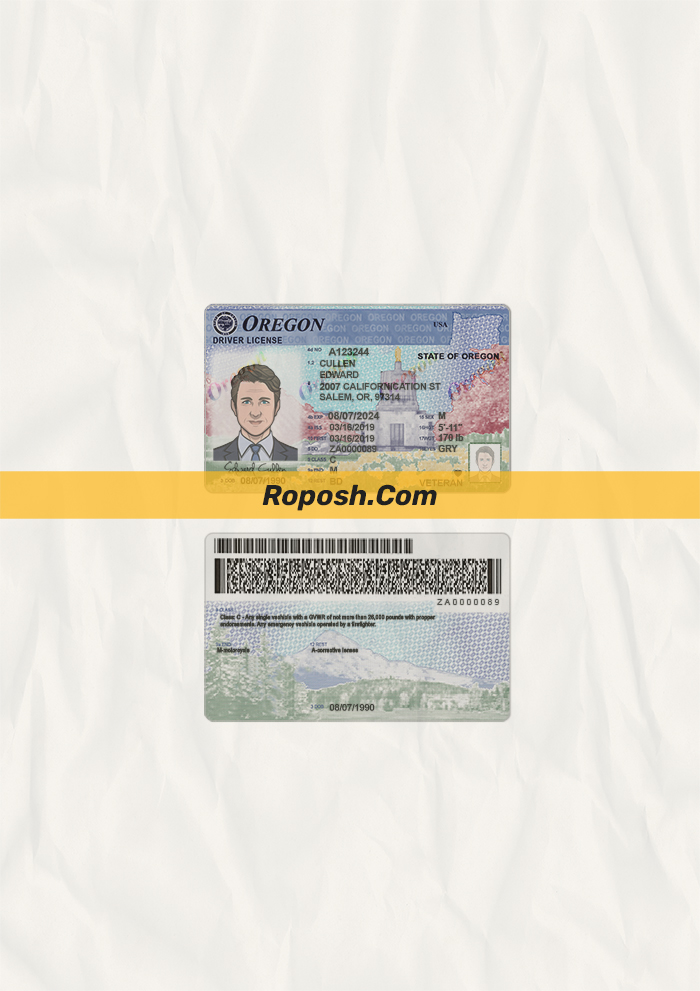
In professional graphic design and print production, the demand for high-fidelity, editable document templates has never been greater. Whether creating detailed design portfolios, crafting educational projects, or preparing realistic mockups, using pixel-perfect templates significantly elevates the quality and credibility of your work. Specifically, designing license templates that reflect precise, standardized layouts and correct font usage is critical to maintaining authenticity in presentation—while adhering only to lawful and illustrative uses. This Oregon driver license PSD template has been meticulously engineered to meet these exacting standards, providing designers and print shop operators with an asset that safeguards design accuracy and print quality from start to finish.
Addressing Layout & Font Challenges
Often, templates suffer from issues such as blurry text borders, inconsistent font application, or poorly organized layers. This template eliminates these common pitfalls by incorporating clean organization and vector-based layers, ensuring crisp detail throughout. The text fields use exact font matching aligned with Oregon’s licensing standards, and the MRZ (Machine Readable Zone) layers mimic correct structural formatting to preserve design integrity. Such attention to detail reduces editing time and prevents blurry or pixelated output. For comprehensive understanding on maintaining OCR-friendly designs and adhering to best practices in editable license layouts, review our guide on OCR-friendly Design.
Technical Specifications Deep Dive
This Oregon driver license PSD template is rendered in a 600 DPI resolution, ensuring ultra-sharp output suitable for professional-grade printing. The color mode is set to CMYK, which optimizes the asset for physical print workflows, guaranteeing exact color reproduction. The template uses smart objects for critical text and photo layers, allowing designers to replace content non-destructively without quality loss. Vector shape layers are implemented for icons, borders, and text elements, enabling infinite scaling without pixelation—critical when scaling for different mockup sizes or print formats. This precise layer architecture aligns with industry best practices, facilitating quick customization and maintaining crispness across all outputs. For complementary assets, consider the editable utility bill PSD to enhance your project’s document suite.
Editing Workflow & Customization
To customize the template, open the PSD file in Adobe Photoshop or compatible software supporting layered PSDs. Text layers are organized using smart objects and properly named for easy identification—allowing for quick replacement of names, dates, and license numbers. Photographic elements reside in designated placeholder layers; simply double-clicking a smart object opens the photo for swap-out with a high-resolution image. Particular attention has been paid to the MRZ and barcode layers, which are vector shapes with locked proportions to retain their standardized structure during edits. This ensures no distortions occur that would compromise professional appearance. For expanding your design library with additional document templates, explore the editable certificate from University of Oregon template.
Exporting & Printing Best Practices
When preparing the final output, export the design as a high-resolution PDF for professional printing or as PNG for digital presentation. Ensure that the export settings preserve layers or embed the color profile to match the template’s CMYK mode. For physical mockups, recommending matte or semi-gloss heavyweight paper will produce authentic tactile results while reducing glare. This combined approach guarantees your final prints maintain the crisp edges and accurate colors designed within the template. To finalize your design collection with additional high-quality documents, consider acquiring the editable certificate from Oregon State University template.
Layer & Field Breakdown
| Layer Group | Description | Editable? | Sample Data |
|---|---|---|---|
| Background | Oregon state license card base with texture and color gradients | No | Standard green & white base |
| Photo Placeholder | High-resolution image container for user photo | Yes | Portrait image |
| Text Fields | Name, Date of Birth, License Number, Address | Yes | John Q. Designer |
| MRZ Layer | Machine Readable Zone with exact font and spacing | Yes (text only) | P<DUGDOE<<JOHN<<<<<<<<<<<<<<<<<<<<<<<<<< |
| Barcode Layer | Vector barcode matching official layout | Yes | 1234567890 |
Precision Editing for Professional Results
Precision editing is crucial to maintain the template’s print-ready integrity. Always edit text fields within smart objects to preserve vector edges and font crispness. When replacing photos, use high-resolution images with similar aspect ratios to avoid distortion or pixelation. Avoid scaling or skewing MRZ and barcode layers to maintain their exact structural dimensions—these must remain consistent with industry standards to reflect authenticity in layout. Utilize layer groups logically to isolate specific elements during batch edits or bulk updates. This disciplined workflow ensures your final output exhibits neat, precise craftsmanship aligning with professional standards expected in high-stakes design portfolios and print productions.


Reviews
There are no reviews yet.