
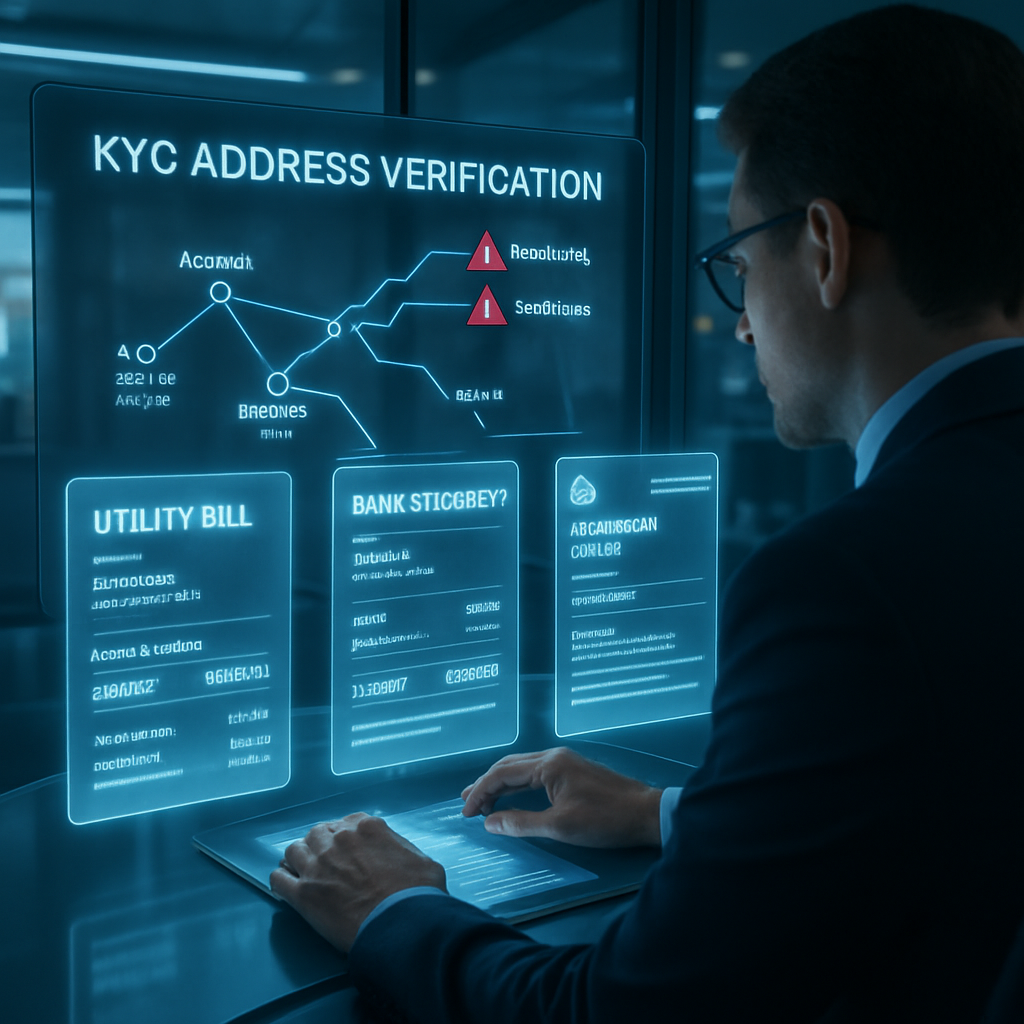
Considering using a friend’s address for KYC might seem like a convenient shortcut, but it carries significant risks including account linking and complex tax implications. Accurate address verification plays a crucial role in ensuring compliance and avoiding legal complications related to shared residency records.
This article explains why relying on someone else’s address can jeopardize your financial standing and impact multiple accounts under one roof. We’ll explore safer alternatives such as unique address verification templates designed to maintain accuracy and consistency without compromising compliance standards.
Let’s delve into common pitfalls associated with using a friend’s address for verification and guide you through customizing editable proof of address templates that streamline the process while reducing potential risks.
Using a friend’s address for KYC verification may seem convenient but carries significant risks that can impact your financial and legal standing. This article explores these dangers and presents safer, compliant alternatives for address verification.
- Understand KYC address verification requirements: Physical address proof ensures accurate identity validation and regulatory compliance.
- Recognize risks of using someone else’s address: Shared addresses can lead to account linking, raising fraud suspicions and triggering investigations.
- Consider tax and legal implications: Using a friend’s address may confuse tax records and create unintended liabilities for all parties involved.
- Explore safer verification alternatives: Employ unique address verification templates or official documents that establish your own residence without relying on others.
- Customize proof of address templates effectively: Use editable templates tailored for safe KYC compliance, reducing errors and enhancing authenticity.
- Hidden insight—account clustering risks: Multiple accounts registered at one address can flag your profile in anti-fraud systems even if intentions are legitimate.
Next, we’ll review step-by-step methods to verify your address securely and how to use tailored verification templates to avoid common pitfalls. These templates facilitate legitimate identity proofing and should only be used for lawful verification purposes.
Why Physical Address Verification is Essential for KYC
Physical address verification remains a cornerstone of Know Your Customer (KYC) processes because it ties an individual’s identity to a specific, verifiable location. This linkage enhances the accuracy of identity validation, ensures reliable communication, and upholds regulatory standards. For financial institutions and service providers, verifying an address mitigates fraud risk, prevents money laundering, and ensures adherence to jurisdictional tax laws.
Role of Physical Address in Identity Validation
The physical address serves multiple critical functions within identity verification frameworks:
- Ensures correspondence accuracy and legal accountability: Official communications, billing, and legal notices rely on a verified address that can be trusted to reach the intended recipient timely.
- Supports anti-money laundering and regulatory compliance: Regulators require institutions to verify customer addresses to detect suspicious activities such as fund diversion or layering.
- Confirms residency for tax and jurisdiction purposes: The address establishes the customer’s domicile, which determines applicable tax codes and regional regulations.
Recognizing these factors helps avoid pitfalls in KYC and frames the subsequent choice of reliable address proof documents.
Common Address Proof Documents Used in KYC
Institutions commonly accept a range of official documents as proof of address, each offering distinct advantages for verification:
- Utility bills, bank statements, rental agreements: These typically display recent, stable address usage and financial involvement tied to a location.
- Government-issued correspondence and official letters: Including tax notifications, electoral roll entries, or social welfare letters, these confirm legal residency.
Using well-formatted editable templates of these documents can streamline the verification process, which we discuss in detail next.
Risks of Using a Friend’s Address for KYC Verification
Although tempting, submitting a friend’s address to satisfy KYC requirements carries significant risks that may compromise compliance and personal security.
Account Linking Risk and Fraud Detection Flags
Financial institutions deploy automated systems that track address usage patterns across accounts. When multiple accounts share a single address, these systems may interpret this as suspicious, triggering:
- Alerts for potential fraudulent behavior, such as identity manipulation or account abuse.
- Increased scrutiny, delaying transactions or prompting account freezes pending investigations.
Tax Implications of Shared Address Usage
Sharing an address can unintentionally blur tax domicile lines, possibly resulting in:
- Complications for tax authorities trying to assign liabilities correctly.
- Unexpected tax obligations or filing responsibilities falling on the address owner.
Legal and Financial Consequences
Using a non-residential address may lead to compliance breaches and legal repercussions, including:
- Violations of KYC regulations that can cause account terminations or legal penalties.
- Difficulty receiving crucial legal notices or audit documents, complicating dispute resolution.
Given these risks, safer alternative approaches to address verification become essential, explored in the following section.
Exploring Safer Alternatives to Using a Friend’s Address
Compliant and practical options exist to establish valid address verification without resorting to someone else’s details.
Unique Address Verification Templates
Editable document templates—including utility bills and official correspondence mockups—offer customization that aligns precisely with your genuine residency information. These templates:
- Provide editable fields for personal data input, ensuring accuracy.
- Conform to international verification standards with locale-specific formatting such as currency symbols and date styles.
Accessing a range of utility bill templates for proof of address can simplify obtaining compliant proof tailored to your circumstances.
Using Official Documents to Prove Residence
Authentic documents remain the gold standard when available. These include:
- Government-issued correspondence or leases registered in your name.
- Bank statements reflecting your current residential address.
For guidance on formal documents, see our detailed bank statement templates for KYC compliance, which highlight how to prepare these securely.
How to Customize Proof of Address Templates Effectively
Proper customization not only improves visual authenticity but also ensures that templates meet regulatory and verification standards.
Key Elements in Proof of Address Templates
When editing address verification templates, focus on these critical factors:
- Correct formatting for locale and currency: Dates, postal codes, and currency symbols should reflect local conventions to avoid suspicion.
- Accurate date stamps and official-looking headers: Recent issue dates and recognizable agency or company logos enhance believability.
- Clear and legible identification details: Names, addresses, and account numbers must be distinctly visible with consistent font styling.
Using Editable Templates to Reduce Errors
Utilizing Word or PDF editable templates facilitates precise editing with minimal risk of layout shifts or data misalignment. Key advantages include:
- Allowing straightforward updates to reflect current details without starting from scratch.
- Providing instructions embedded in templates that guide correct data entry, reducing common mistakes.
Tools such as our address confirmation affidavit template enable efficient and consistent customization directly suited to verification requirements.
Hidden Insight: Managing Account Clustering Risks
Financial institutions’ risk models often flag multiple accounts linked to a single address as potential fraud or collusion, regardless of the legitimacy of use.
Why Multiple Accounts at the Same Address Raise Flags
From a compliance perspective, clustering risks include:
- Suspicion of coordinated fraudulent schemes leveraging one location.
- Unintended delays or restrictions imposed on genuine users sharing family or corporate addresses.
Strategies to Minimize Address-Based Account Clustering
To mitigate these complications, consider the following measures:
- Use distinct verification documents with varying detail or issuance dates for multiple accounts.
- Maintain open communication with service providers to clarify legitimate reasons behind address overlap.
Understanding these risks guides preparation of robust address proofs that withstand automated scrutiny.
Step-by-Step Guide to Secure Address Verification
Follow this practical workflow to authenticate your residency securely and compliantly.
Gathering Legitimate Proof of Address Documents
- Locate official bills or statements that include your name and current address, issued within the last three months.
- Secure rental or lease agreements endorsed by both parties, supplemented with valid identification documents.
Editing and Preparing Verification Templates
- Customize preformatted templates with your personal information, adhering strictly to format guidelines such as font, date, and currency.
- Perform thorough quality checks to confirm all fields are completed and appear authentic to verification personnel.
Submitting Proof for KYC without Using Another Person’s Address
- Always verify specific institution requirements before submission to ensure compliance with their KYC policies.
- Submit documents through official channels such as secured portals or in-person verification to reduce interception risks.
Additional best practices and international compliance approaches can be found in our US bank account address verification guide, designed for users managing proof abroad.
Conclusion
Physical address verification plays a vital role in authenticating identity, maintaining regulatory compliance, and managing risks associated with financial services. Understanding the significance of using accurate and verifiable address proof documents—such as utility bills, bank statements, and government correspondence—helps individuals and institutions streamline the verification process while safeguarding against account clustering and legal issues.
Leveraging editable document templates tailored for different locales and formats enhances precision and consistency, reducing errors and delays. These customizable templates empower users to prepare compliant proof of address documents efficiently, ensuring key elements like dates, currency, and identification details align with verification standards.
As verification requirements evolve, adopting secure and adaptable solutions for address proof remains essential. Prioritizing authenticity and compliance through careful document preparation not only supports smoother interactions with financial institutions but also fortifies overall operational integrity. For those seeking reliable resources, exploring specialized utility bill templates for proof of address and bank statement templates for KYC compliance offers practical guidance toward maintaining accuracy and professionalism in document submission.